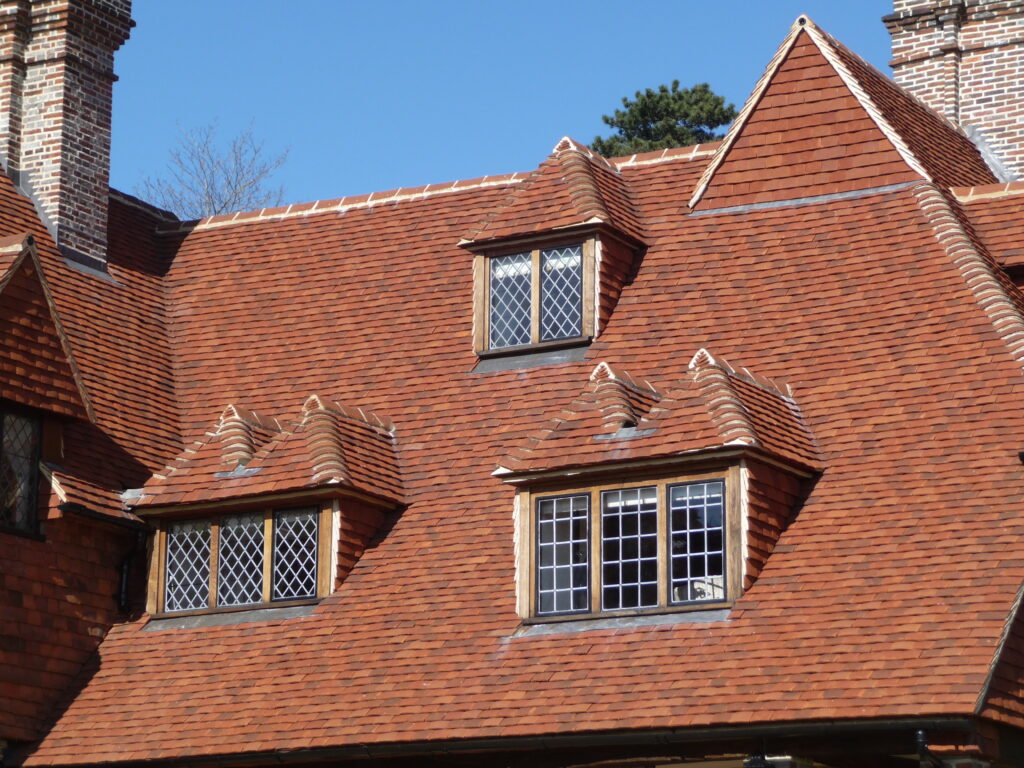
Over a century ago most tiles were made as ‘peg’ tiles i.e. they had no nibs from which the tile is hung, just two holes usually square through each of which a wooden peg is pressed and the tile was hung from these pegs. During 1477 a royal statute was issued to attempt to standardise tile sizes in England to 10 ½” x 6 ¼” which is very close to the current standard today of 10½” x 6 ½”. However, some areas of the country steadfastly stuck to their regional sizes, either out of ignorance or defiance. Leicester maintained the sizes of 11″ x 7″, Kent 10″ x 6″ and some areas of East Sussex seem to be 9 ½” X 6 ¼”, in truth both the latter had regional differences for what ever reason. However, the Kent peg remains as popular as ever and arguably that half an inch smaller is a very attractive format and very noticeable.
Although these differences may seem small, when a repair or extension work is being carried out it is desirable to use the correct size. Your Handmade Manufacturer will be sensitive to these issues and should assist to help you through your project.
The Kent peg tile, with a coverage of 72 per square metre, is generally, set on a gauge of 3.5 inches. A peg roof, either Kent size or standard, 60 tiles per square metre, may be specified if the underside of the roof is unclad; the pegs being visible to the onlooker. Where a standard peg is specified but the roof is clad, then using a standard nib tile will produce an identical external effect and be less expensive.